Published Articles

Published Articles by Shemrock bring you expert insights on parenting, early childhood education, preschool learning, child development, and school selection. Our articles are thoughtfully written to guide parents, educators, and caregivers with practical tips, research-backed advice, and real-world perspectives. Explore our published content to stay informed and make confident decisions for your child’s holistic growth and learning journey.

How to Prepare Your Child for Preschool 5 Practical Tips

Preschool Preparation: 5 Smart Tips for Parents

The admission is confirmed. The uniform is bought. The school bag is sitting by the door. And somewhere between excitement and quiet worry, you are asking the question every parent asks at this point: have I done enough to prepare my child for this? The good news is that preparation for preschool does not require anything complicated. It requires consistency, the right conversations and a few weeks of intentional routine-building before the first day. Done well, it transforms what could be an anxious transition into a confident one — for your child and for you. Here are five practical tips that actually work. Why Preparation Matters More Than Most Parents Expect Starting preschool is not just a logistical change for a young child. It is the first time they are being asked to navigate a world that is entirely separate from their parents — with unfamiliar people, unfamiliar spaces and unfamiliar expectations. Children who are prepared for this transition settle in faster, experience less separation anxiety and develop a more positive relationship with school from the very beginning. Children who arrive with no preparation are not harmed — but their first few weeks are harder than they need to be. The goal of preparation is simple: make the unfamiliar feel a little more familiar before day one. The 4-Week Preparation Window You do not need months. Four weeks of consistent, low-pressure preparation is enough to make a meaningful difference. Here is how to think about it. Weeks 3–4 Before School: Build Familiarity This is the awareness phase. Start talking about preschool naturally — not constantly, not with forced enthusiasm, just casually and positively. Introduce books about starting school. If possible, drive past the school and mention it without making a big event of it. Week 2 Before School: Practise the Routine Start shifting your child’s morning schedule to match the school day. Wake-up time, breakfast, getting dressed — run through the sequence in the order it will happen on school days. Familiarity with the morning routine removes one layer of newness on the first day. Week 1 Before School: Make It Real and Positive This week is for specifics. Pack the school bag together. Let your child choose where it lives by the door. Talk about who their teacher will be. Keep the tone warm and matter-of-fact — school is a normal, exciting thing that is about to happen. Tip 1 — Start the Separation Practice Early (and Keep It Small) For most children, the hardest part of starting preschool is not the school itself — it is the moment you leave. Separation anxiety at age 2 to 4 is completely normal. It is not a sign that your child is too young or not ready. It is a sign that they love you and feel safe with you. The goal is not to eliminate that — it is to help them develop the confidence that you will always come back. Start small. Leave your child with a trusted family member or caregiver for 30 minutes while you go to a different room or step outside. Gradually extend this to an hour, then longer. The key is consistency: you say goodbye, you leave, you come back. Every time you return, you are building the most important piece of school readiness there is — the understanding that separation is temporary. What to Say Most parents say too much at drop-off — long reassurances, repeated goodbyes, emotional apologies. This actually increases anxiety because it signals to the child that there is something to worry about. Instead, try this: “I’m going now. I’ll be back after snack time. Have fun.” “Your teacher is here. I’ll see you soon.” “I love you. See you later.” Say it once. Mean it. Leave. Come back when you said you would. That consistency is more reassuring than any words. Tip 2 — Build the School Routine Before School Starts Young children find security in predictability. When the morning routine on the first day of school feels completely different from every other morning, it adds a layer of stress that has nothing to do with school itself. Two weeks before school starts, begin running the actual school-day morning sequence: Wake up at the same time school mornings will require Breakfast at the school-day time Get dressed in the uniform or similar clothing Pack the school bag and put it by the door You do not need to go anywhere. You are just making the sequence familiar. By the time the first real school morning arrives, the routine itself will feel normal — and that familiarity is grounding for a young child stepping into an unfamiliar environment. Tip 3 — Talk About Preschool — But Do It Right How you talk about school in the weeks before it starts shapes how your child feels about going. Most parents instinctively oversell it — “You’re going to have SO much fun! It’s going to be amazing!” — which creates expectations that the reality may not immediately match, especially in the first uncertain week. Talk about school as a normal, positive thing. Mention the specific elements your child will enjoy — the play areas, the songs, the other children, the teacher. Keep it concrete and real, not a sales pitch. What to Say (and What Not to Say) Say: “At school, you’ll have a teacher called [name] who will play with you.” “There will be a sandpit / painting / story time — things you love.” “After school, I’ll be right there waiting for you.” Avoid: “Don’t cry, it’ll be fine” — this dismisses the emotion rather than validating it “If you’re good, I’ll get you a treat” — links school behaviour to reward, creates performance anxiety “I’ll miss you so much” — transfers your anxiety directly to your child The goal is calm, warm and specific. Not effusive, not anxious. Tip 4 — Visit the School Before Day One A campus visit before the first official day does something that

Preschool Preparation: 5 Smart Tips for Parents Read More »

PlayGroupVsNursery

Playgroup vs Nursery: What’s Right for Your 2-Year-Old?

Author: SHEMROCK Heritage | Published: April 2026 | Reading Time: 6 minutes Playgroup vs Nursery: What’s Right for Your 2-Year-Old? Most parents searching this question already know the basics — playgroup is for younger children, nursery comes after. What they actually need to know is: which one is right for my child, today, given exactly where they are right now? The honest answer is that age on a birth certificate is only the starting point. A 2-year-old who communicates clearly, separates easily and shows curiosity about other children is in a very different place than a 2-year-old who is still deeply attached, pre-verbal and overwhelmed by new environments. Both are completely normal — but they need different starting points. This guide gives you the framework to decide — not just the definitions. The Short Answer Playgroup is designed for children aged 2 to 2.5 years who are beginning their first structured experience outside the home. Nursery is designed for children aged 3 years and above who are ready for a more defined curriculum, peer interaction and early academic foundations. If your child is 2 years old, playgroup is almost always the right starting point — but developmental readiness matters more than the number. Programme Typical Age Core Focus Playgroup 2 – 2.5 years Transition from home, sensory play, social basics Pre-Nursery 2.5 – 3 years Early language, creativity, structured routine Nursery 3 – 4 years Early literacy, numeracy, emotional development Preparatory 4 – 5 years School readiness, independence, cognitive foundations What Is Playgroup — and What Actually Happens There? Playgroup is not just supervised babysitting with toys. At its best, it is a carefully designed first experience of the world outside home — structured enough to build confidence, gentle enough not to overwhelm. The primary goal of playgroup is not academic. It is relational and transitional. Children at 2 years are still in a deeply attachment-led phase of development. The most important thing playgroup does is help them learn that the world beyond their parents is safe, interesting and worth exploring. What a Typical Playgroup Day Looks Like Free sensory play — sand, water, clay, textures — stimulating fine motor development and curiosity Circle time — songs, rhymes and simple group activities that introduce the concept of shared learning Structured free play — children choose activities within a prepared environment Storytime — early language exposure through picture books and narration Snack time — social eating, basic table manners, routine familiarity There is minimal sitting, minimal instruction and zero academic pressure. The learning is happening — just not in a way that looks like studying. What Is Nursery — and How Is It Different? Nursery builds on playgroup foundations. By age 3, most children have developed enough emotional regulation, language and social awareness to engage with a more structured day — one that begins introducing early literacy, numeracy and group learning in a meaningful way. The shift from playgroup to nursery is not just about content. It is about readiness for sustained engagement. A nursery child is expected to follow a more defined schedule, participate in group activities and manage longer periods of focused learning. What a Typical Nursery Day Looks Like Morning group activities — structured learning with a teacher, focused on a weekly theme Language and literacy — phonics introduction, vocabulary building, storytelling Early maths — counting, sorting, patterns through play-based activities Creative expression — art, craft and drama as learning tools Outdoor play — physical development, coordination and social interaction Value-based activities — sharing, turn-taking, empathy building The atmosphere is warmer and less structured than primary school — but more defined than playgroup. Age Is a Guide. Developmental Readiness Is the Answer. This is the part most articles skip — and the part parents actually need. Two children can both be 2 years and 4 months old and be in completely different places developmentally. Neither is advanced or delayed. They are just different children, on different timelines — both of which are entirely normal. What this means practically: before deciding between playgroup and nursery for your 2-year-old, look at your child, not the calendar. Signs Your 2-Year-Old Is Ready for Playgroup Shows interest in other children Can cope with brief separation Communicates basic needs Follows simple instruction Shows curiosity in new environment Signs Your Child Might Be Ready to Move Directly to Nursery Separates comfortably Uses short sentences Engages in play Interested in structured activities Can sit for short time What Happens If You Choose the Wrong One? If you start playgroup and your child is ready for more, they will adjust quickly. If nursery is too early, it may cause stress and reluctance. How to Decide — A Simple Framework Assess readiness signs Visit school Ask for honest assessment Explore more: Best Preschool in Rohini Ready to See the Right Fit? Visit SHEMROCK Heritage, Rohini Book Campus Visit FAQ What age is playgroup for in India? Playgroup starts at 2 years. Can a 2-year-old go to nursery? Usually no unless developmentally ready. What is difference between playgroup and pre-nursery? Playgroup is transition stage, pre-nursery adds structure. Is playgroup necessary? Not mandatory but highly beneficial. How to know readiness? Check communication, curiosity and separation comfort.

Playgroup vs Nursery: What’s Right for Your 2-Year-Old? Read More »

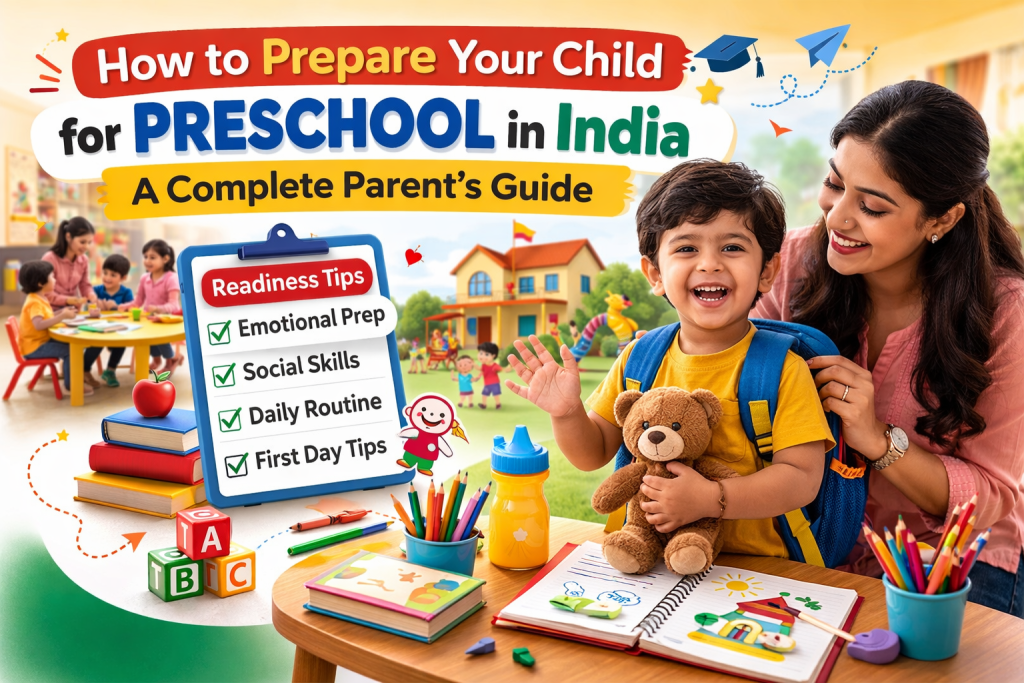
How to Prepare Your Child for Preschool in India | Parent Guide

Sending your child to preschool for the first time is not just an admission milestone — it’s an emotional turning point for the entire family. For many Indian parents, this phase comes with mixed feelings: Will my child cry every day? What if they refuse to stay in class? Are they too small? Have I prepared them enough? If you’re feeling anxious, you’re not alone. Every year, thousands of first-time parents search for how to prepare child for preschool in India, and most of them share the same concerns. The good news? With the right preparation, preschool becomes a joyful beginning — not a stressful one. This complete parent’s guide will walk you through everything you need to know — emotionally, socially, and practically — to make your child’s preschool journey smooth and confident. When Is the Right Age for Preschool in India? In India, preschool admissions generally follow this age structure: Playgroup: 2–3 years Nursery: 3–4 years LKG (Lower Kindergarten): 4–5 years However, preschool readiness is not just about age. It’s about developmental readiness. Signs Your Child Is Ready for Preschool Your child may be ready if they: Show curiosity about other children Can sit for 5–10 minutes for a simple activity Follow basic instructions (“Give me the ball”) Express basic needs verbally or through gestures Manage short separations from parents If your child is still clingy or shy, don’t panic. These are common and manageable through gradual preparation. Emotional Preparation: Reducing Separation Anxiety One of the biggest concerns parents have about the first day of preschool is separation anxiety. Let’s understand this clearly:Crying in the first few days is normal. It does not mean your child is not ready. How to Reduce Separation Anxiety Before Preschool 1. Practice Short Separations Start small: Leave your child with grandparents for an hour. Encourage playdates where you step away briefly. Attend hobby classes where they sit independently. Gradual exposure builds confidence. 2. Talk Positively About School Use excitement, not fear. Instead of saying: “If you don’t listen, I’ll send you to school!” Say: “You’ll make new friends and play with toys at school!” Children absorb your tone more than your words. 3. Create a Goodbye Ritual A simple routine works wonders: One hug One high-five One cheerful “See you soon!” Consistency makes transitions predictable and comforting. 4. Manage Your Own Emotions Children sense parental anxiety instantly. If you look worried at drop-off, your child will feel unsafe.Stay calm, confident, and cheerful — even if you’re emotional inside. Social Preparation: Helping Your Child Interact Confidently Preschool is often a child’s first structured social environment. Here are essential preschool readiness tips: Teach Sharing and Turn-Taking At home: Play simple board games. Practice taking turns while playing with blocks. Say: “Now it’s mamma’s turn, then it’s your turn.” Encourage Interaction with Other Children Arrange playdates. Visit parks regularly. Encourage group activities. Even observing other children helps shy kids adjust. Teach Basic Manners Simple habits matter: Saying “please” and “thank you” Greeting teachers Asking before taking toys Following Simple Instructions Practice 2-step commands: “Pick up your shoes and keep them in the rack.” “Bring your bottle and sit here.” This helps during classroom routines. Building Independence Skills: Preschool Preparation Checklist Preschool is smoother when children can manage basic tasks independently. Preschool Preparation Checklist Eating Skills Eats with a spoon independently Drinks from a cup or bottle without spilling Sits in one place while eating Toilet Readiness Can communicate toilet needs Wears easy-to-remove clothing Basic toilet training initiated Hygiene Habits Washes hands with guidance Uses a handkerchief Covers mouth while sneezing Dressing Skills Wears shoes (with assistance if needed) Recognizes their own bag and bottle Responsibility Basics Helps pack their bag Identifies personal belongings Remember: perfection is not required. Basic familiarity is enough. Establishing a Preschool Routine Routine reduces anxiety. Start preparing at least 2–3 weeks before school begins. 1. Align Sleep Schedule 10–11 hours of night sleep Fixed bedtime Wake up at school time daily Late-night screen habits must reduce gradually. 2. Practice a Morning Routine Simulate school mornings: Wake up Brush Get dressed Eat breakfast Leave the house Make it fun and predictable. 3. Reduce Screen Time Excessive screen exposure affects attention span. Replace screens with: Picture books Storytelling Puzzles Building blocks 4. Build Healthy Eating Habits Encourage: Simple home-cooked meals Fruits Finger foods they can manage independently Preparing for the First Day of Preschool Here’s a step-by-step plan to make the first day of preschool smoother. Step 1: Visit the School Beforehand Show the classroom Introduce the teacher Let your child explore the environment If considering admissions, explore the Preschool Admission in India process early. Step 2: Meet the Teacher Build trust: Share your child’s habits Mention allergies or concerns Ask about adjustment support Step 3: Pack Smart Typical essentials: Extra clothes Labeled water bottle Small napkin Comfort object (if allowed) Step 4: Say Goodbye Confidently Keep it short. Do not sneak away. Do not return repeatedly if they cry. What NOT To Do Don’t threaten with school. Don’t compare with other children. Don’t prolong drop-off. Handling the First Week of Preschool The first week may include: Crying at drop-off Clinginess at home Temporary sleep changes This is normal. How Long Does Adjustment Take? Typically: 3–7 days for some children 2–4 weeks for others Every child has a different temperament. How Parents Should Respond Stay calm and consistent. Avoid dramatic reactions. Celebrate small wins. Communicate with Teachers Good preschools maintain strong parent communication. Regular updates reassure you. At institutions like Shemrock Group of Schools, teachers actively support transition and emotional adjustment through child-centric methods. Common Mistakes Parents Make 1. Comparing Children Every child develops differently. Avoid: “See, Riya doesn’t cry!” Comparison increases anxiety. 2. Over-Preparing Academically Preschool is not about writing A-Z fluently. Focus on: Social skills Emotional security Curiosity 3. Staying Too Long During Drop-Off Lingering makes separation harder. 4. Speaking Negatively About School Children internalize your language. How Parents Can Support Learning at Home Preschool learning continues at home. Build

How to Prepare Your Child for Preschool in India | Parent Guide Read More »

Banner

Selecting the right school for your child

Make a smart choice when it comes to selecting the right school for your child! Read the article by Mrs. Meenal Arora, Director – SHEMROCK & SHEMFORD Group of Schools, to know the various factors you should take into consideration while selecting the right school for your child. The article is featured in popular Online Portals India Today & Express Parenting section of Indian Express. Read online: http://bit.ly/2sdcL1Q Read online: http://bit.ly/2LD1ZsT

Selecting the right school for your child Read More »

5 proven ways to raise happy and healthy kids, even as the air quality continues to go down.

In the wake of rising air pollution in Delhi/NCR, are you doing your bit as a responsible and aware parent? Read the article authored by Mrs. Meenal Arora, Director – SHEMROCK & SHEMFORD Group of Schools, featured in The Financial Express, where she shares 5 proven ways to raise happy and healthy kids, even as the air quality continues to go down. https://bit.ly/2WDPNMN

5 proven ways to raise happy and healthy kids, even as the air quality continues to go down. Read More »

5 tips to maintain your child’s physical and mental health in the deteriorating air quality

Is rising air pollution affecting your child’s health? Mrs. Meenal Arora, Director – SHEMROCK & SHEMFORD Group of Schools has shared 5 tips to maintain your child’s physical and mental health in the deteriorating air quality on the prestigious online portals ‘Times Now News’ & ‘Health Vision’. Read her complete article here: https://bit.ly/2JEbmHG https://bit.ly/2C3IQLf

5 tips to maintain your child’s physical and mental health in the deteriorating air quality Read More »

How schools can help working parents strike a balance between their jobs and give quality time to the children

Do you wonder how schools can help a working parent achieve work life balance? Check out this article by Mrs. Meenal Arora, Director – SHEMROCK & SHEMFORD Group of Schools, on “How schools can help working parents strike a balance between their jobs and give quality time to the children”, published on the Education Times online portal. Check out the complete article here: http://bit.ly/2pdPiMD

How schools can help working parents strike a balance between their jobs and give quality time to the children Read More »

Are you aware that we tend to raise our children with Gender biases?

Are you aware that we tend to raise our children with Gender biases ? Then check out these tips by Mrs. Meenal Arora, Director – SHEMROCK & SHEMFORD Group of Schools, published on page no. 3 of today’s The Statesman Newspaper on what steps we can take to help our children grow into well rounded individuals!

Are you aware that we tend to raise our children with Gender biases? Read More »